
By Dorothy Musyoka
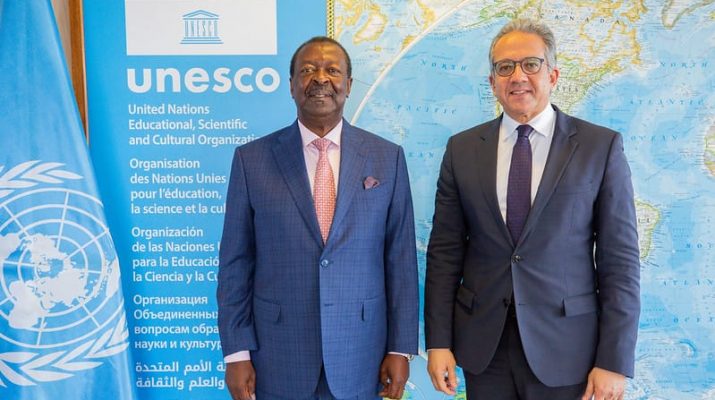
Kenya has taken a significant step toward strengthening UNESCO’s presence on the continent following high-level talks with the Director-General of the United Nations Educational, Scientific and Cultural Organization (UNESCO), Prof. Khaled Ahmed El-Enany Ali Ezz, at the Organization’s headquarters in Paris, France.
The meeting advanced Kenya’s proposal to position Nairobi as a UNESCO Regional Hub for Africa, in alignment with the ongoing UN80 reforms and broader efforts to deepen UNESCO’s footprint and effectiveness across the continent.
The proposed hub would enhance coordination, programme delivery, and partnerships in education, science, culture, and communication, while reinforcing Africa’s voice within the multilateral system.
According to Prime Cabinet Secretary Musalia Mudavadi, discussions also welcomed UNESCO’s confirmation of its readiness to work closely with Kenya, in collaboration with African Union frameworks, toward hosting the World Conference on Education for Sustainable Development in 2026.
“We also welcomed UNESCO’s confirmation of its readiness to work with Kenya and African Union frameworks toward hosting the World Conference on Education for Sustainable Development in 2026 as a high-impact global gathering,” stated Mudavadi.
The conference is envisioned as a high-impact global gathering that will accelerate action on education as a driver of sustainable development, innovation, and social transformation.
Further engagements focused on expanding cooperation in science and innovation, including water security initiatives for vulnerable and arid regions such as Turkana.
The talks also highlighted Kenya’s commitment to strengthening African scientific capacity, notably through initiatives such as the proposed African beamline at the SESAME synchrotron, which would enhance access to advanced research infrastructure for scientists across the continent.
Kenya reaffirmed its firm commitment to UNESCO’s ideals and objectives, guided by Vision 2030 and the Sustainable Development Goals (SDGs).